The Undermining of Congress

Leg Branch Spending 1995-2020

The Legislative branch plays a central role in our democracy, but for decades Congress has systematically underfunded congressional operations as compared to the rest of government.

The chart below shows discretionary non-defense discretionary spending from 1995-2020 (in constant dollars). During that quarter-century, non-defense discretionary spending increased by 58%, but spending for the legislative branch increased only by 27%.

Discretionary Appropriations Spending from 1995-2020
Percentage Change in Non-defense appropriations discretionary spending 1995-2020
Continue reading “The Undermining of Congress” →

2020 Legislative Branch Wish List

The passage of the Legislative Branch Appropriations bill for FY 2020 back in December started the clock on a number of projects and reports inside the legislative branch. We took a look at the requests, broke them down by office, and summarized the deadlines, which are drawn from the House committee report, the Senate committee report, and the Joint Explanatory Statement.

2020 Leg Branch Item Check List (1)

Continue reading “2020 Legislative Branch Wish List” →

25 Years of Legislative Branch Appropriations

Every year Congress determines exactly how much money will be made available to the Legislative Branch and the purpose for which it can be spent. The Legislative Branch Appropriations bills directs congressional spending, line-item by line-item — but, alas, the instructions are published as prose, can run for dozens of pages, and it is difficult to see how appropriations spending has changed over the decades.

We’ve gone through  all of the spending bills for the last quarter-century and lined up the spending items in a downloadable spreadsheet. Now you can see how spending on each line-item has changed from 1994 forward.

Peruse the Legislative Branch budget line items from fiscal years 1994-2020 below, or download the data set here.  Continue reading “25 Years of Legislative Branch Appropriations” →

First Branch, Second-Rate Funding

Of the $4.7 trillion proposed federal budget for FY 2020, $1.4 trillion is discretionary spending, that is,optional spending made through appropriations bills. Before Congress can spend that money, it is divided into 12 slices—one for each of the 12 appropriations subcommittees. These slices are called 302(b) allocations. 

Lawmakers are supposed to agree on 302(b) numbers early in the appropriations cycle, but this time around the agreement was (very) delayed. Without finalized topline numbers, lawmakers weren’t able to negotiate over the line items in the spending bills; after all, how could they dole out funds if they didn’t know how much money they were working with in the first place? 

Since Fiscal Year 2020 started on October 1st, lawmakers have pieced together short-term-spending agreements, or continuing resolutions, to keep the government’s lights on. Lawmakers finally agreed on final 302(b) numbers for FY 2020 at the end of November, and earlier this week Appropriators introduced two minibus bills that will keep the government funded for the remainder of FY 2020. 

So, what do the numbers tell us?

Continue reading “First Branch, Second-Rate Funding” →

Appropriators Should Provide Adequate Funding to Congress

Congress is significantly underfunded — especially compared to the executive branch — and it has suffered deep staff cuts over the last 25 years. In March and in September, we co-authored letters naming the fact that not only does the Legislative Branch receive the smallest funding level of the 12 appropriations subcommittees, it has received funding cuts (in real terms) over the last decade even as other appropriations subcommittees have received increases.

As we speak, the House and Senate are negotiating over how much in new funding to give to each of the 12 appropriations subcommittees. In play is how to divvy up a significant increase in overall funding: a $27 billion increase in non-defense discretionary spending over the next fiscal year.

According to CRS, in FY 2019 the legislative branch was funded at $4.836 billion. How does the proposed increases in Leg Branch funding from the House and Senate compare to last year’s funding level?


Screenshot 2019-10-31 at 11.57.43 AM
Comparison of proposed changes in the allocation to the Legislative Branch Appropriations Committee for FY 2020, in millions of dollars.

Continue reading “Appropriators Should Provide Adequate Funding to Congress” →

The Leg Branch Approps To-Do List for FY 2019

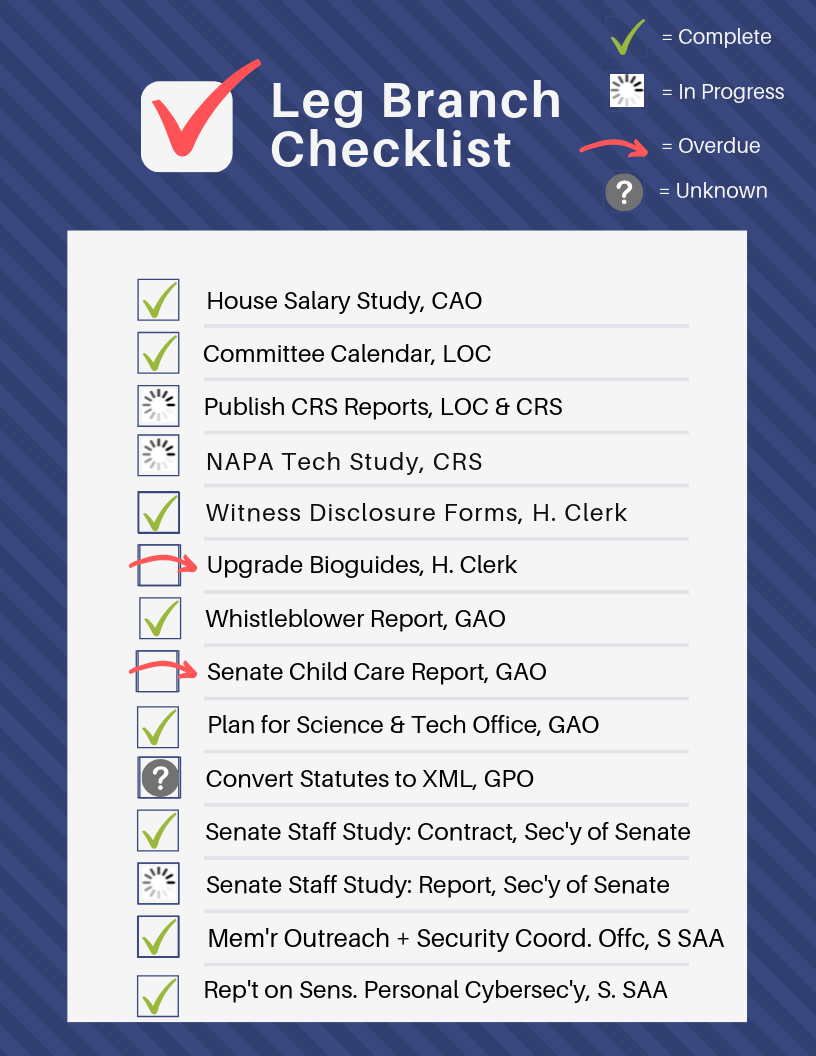
Congress requested a number of improvements to how the legislative branch functions as part of the Legislative Branch Appropriations Act for Fiscal Year 2019 (and, in one instance, for FY 2018). What happened?

We reviewed the status of requested leg branch projects in the following chart and then provided an issue-by-issue analysis. We expect to have more status updates at this week’s upcoming Legislative Data and Transparency Conference.

Leg Branch Checklist Continue reading “The Leg Branch Approps To-Do List for FY 2019” →

How Senate Committees Get Their Money

TRENDS IN SENATE COMMITTEE FUNDING

How do Senate committees get their funding and how has funding changed over the last 25 years? We crunched the numbers for you and here are the highlights:

  • Senate Committee spending is at an 18 year low
  • It’s good to be an appropriator; the committee gets the lion’s share of the funding and doesn’t have to beg for money
  • While Senate Committees aren’t exactly rolling in dough, they’re in much better shape than House committees, which are on a starvation diet

Continue reading “How Senate Committees Get Their Money” →

The Crystal Ball on Funding for the Office of Technology Assessment

Earlier this year, the House’s Appropriations Committee favorably reported a Legislative Branch Appropriations bill for FY 2020 that contained $6m in start-up funds for the Office of Technology Assessment spread out over two years. Now that the House and Senate have agreed upon top line spending numbers for the federal government, where does all this stand?

As you might recall, the House of Representatives passed 10 out of 12 appropriations bills, but the Legislative Branch bill was not among them. It got hung up on the House floor over an unrelated fight over providing members of Congress with a cost of living increase. Continue reading “The Crystal Ball on Funding for the Office of Technology Assessment” →

The Congress’s Edifice Problem

According to the Architect of the Capitol, it will take several billion dollars to keep the Congress from literally falling apart. This, and much more, was the subject of four legislative branch appropriations hearings this past week.

It’s not just the physical infrastructure of Congress that’s eroding, the power of the institution has taken a hit over the years with budget cuts. The result has been executive branch overreach as well as cyber security and IT practices falling miles behind best practices.

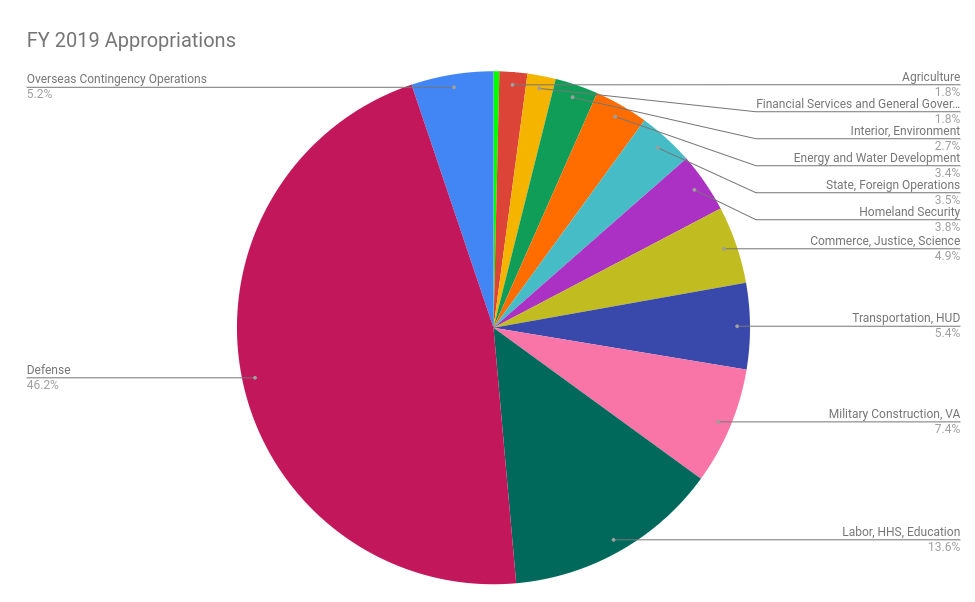
The legislative branch appropriations subcommittee in charge of doling out the funds that keep the branch functioning has the smallest pot of money to work with in the federal government: last year its funding was only approximately $4.3 billion, with overall federal spending about 1000x greater at $4.3 trillion.

To put this in context, $1.244 trillion was allocated to the 12 appropriations committees for FY 2019. The amount for the legislative branch is so small you can’t see it on the chart — it’s the bright green sliver. Here’s the amounts from least to greatest: Legislative Branch ($4.8b), Agriculture ($23b), Financial Services ($23b), Interior & Environment ($35.6b), Energy & Water ($44.6b), State & Foreign Ops ($46.2b), Homeland Security ($49.4b), Commerce & Science & Justice ($64.1b), Transportation & HUD ($71.1b), Military Construction & VA ($97.1b), Labor & HHS & Education ($178.1b), Defense ($606.5b). (There’s an additional $77b for “Overseas Contingent Operations,” of which $67.9b went to Defense.)
Screenshot 2019-03-01 at 5.10.22 PM Continue reading “The Congress’s Edifice Problem” →

How House Committees Get Their Money

(A version of this article updated for the 116th Congress is available here).

Committee funding in the House of Representatives is accomplished through a somewhat quirky process. Appropriators in the House Legislative Branch Appropriations Committee set a top dollar amount for the committees — they appropriate the funds — but it is the Committee on House Administration that provides (i.e. allots) the funds to each committee on a biennial basis.

At the beginning of each new Congress, each committee chair and ranking member jointly testifies before the House Administration Committee and requests funds for their committee. For the 115th Congress, the hearings took place on February 15th and 16th, 2017. Here is the committee notice; the written statements requesting funds; and video from Feb. 15 and Feb. 16.

On March 7th, the House Administration Committee introduced a funding resolution in the House, and on March 8, the committee held a markup on House Resolution 173 that allotted funds to the committees. You can watch the very brief proceedings here. House Administration reported out the committee report a week later on March 15th, and the House passed the resolution on March 17.

HOW FUNDING FOR COMMITTEES HAS CHANGED OVER THE LAST 25 YEARS

What does this look like in practice? Drawing upon the excellent data in this CRS report, plus a little additional research on spending on the appropriations committee, we looked at:

  1. Total committee spending from 1995 to present
  2. The change in spending per committee from 1997 to present
  3. Spending per committee in the last Congress

What did we find? Overall, committees have significantly fewer funds available than their recent historical counterparts, which undermines their ability to do their jobs. Continue reading “How House Committees Get Their Money” →